
Most established HVAC contractors do not have a dozen marketing agencies to manage. Often, they have one primary agency handling paid media, search visibility, the website or several of those functions. The arrangement can work well. Yet the owner still faces a difficult question: is marketing producing the kind of business growth the company needs?
An agency may report improving leads and lower advertising costs while the HVAC company sees uneven booking rates, idle installation crews, or disappointing gross profit. Neither report is automatically wrong. The two parties may simply be measuring different parts of the business. The solution is not to blame the agency for everything. It is to establish a management system that connects its work to operating and financial outcomes.
What does HVAC marketing agency accountability actually mean?
Agency accountability means defining the results the agency can reasonably influence, giving it access to trustworthy feedback, and reviewing those results against clearly agreed goals. Executive accountability is broader: someone inside or acting for the company must decide which service lines and markets deserve investment, how demand matches capacity, and whether the full marketing system supports profitable revenue.
That distinction matters. An agency cannot control whether a dispatcher answers the phone, whether technicians can accept another install, or whether a comfort advisor closes a replacement estimate. But it should be able to explain its campaign decisions, lead-quality assumptions, reporting methods, and recommended changes. Both sides need a shared scoreboard rather than competing dashboards.
Why lead reports can hide the real problem
Clicks, forms and calls show activity at the front end of demand. They do not automatically represent new customers. Calls can be repeat customers, wrong-service requests or unanswered opportunities. Form fills can be duplicates. Bookings can cancel. Completed jobs can have very different margin profiles. A dashboard that stops at cost per lead is useful for campaign optimization, but insufficient for a CEO deciding the next quarter’s budget.
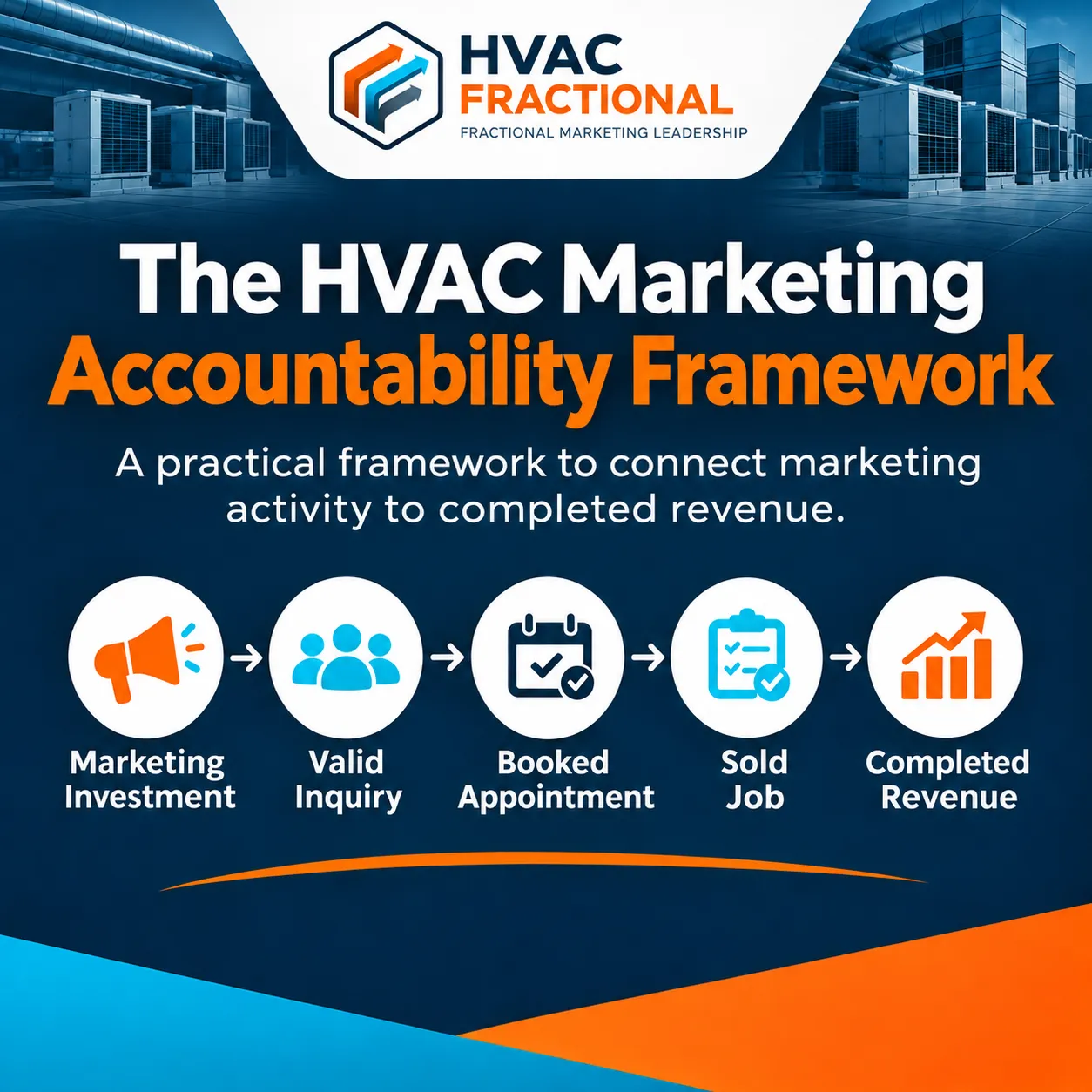
Consider a hypothetical scenario, not an HVAC Fractional client result. An agency generates 200 tracked inquiries. Of those, 140 are valid, 100 book, 80 complete, and 20 become replacement jobs. A second campaign generates fewer inquiries but more profitable completed work. The CEO needs to see both the agency’s acquisition efficiency and the downstream business outcome before shifting spending.
The owner should not demand a perfect single-source attribution model. Customers may notice an HVAC brand through search, reviews, trucks, referrals and prior service before making contact. Instead, agree on consistent source definitions, document gaps and use directional evidence for decisions.
Begin with one company-level growth objective
Before reviewing agency performance, the owner and leadership team should establish a measurable commercial objective: for example, grow completed replacement revenue within available installation capacity while protecting target gross margin. They then translate it into demand targets, conversion expectations, service-line priorities and spending constraints. Numbers should be based on company data and finance-approved definitions, not universal benchmark promises.
The agency’s plan should respond to that objective. That may mean fewer low-intent leads, different geographic emphasis, better landing-page quality or more deliberate brand investment. Sometimes the correct response is not higher advertising spend. It is improving booking, follow-up or available field capacity.
Give the agency a practical performance agreement
Here is a useful distinction for the monthly review: an agency may own campaign setup, budget pacing and reporting accuracy, while the company controls call handling, close rates, field scheduling and collected revenue. If results deteriorate, first identify where the change occurred rather than assuming which party is responsible. That is especially important when weather, staffing and service mix change across the same reporting period.
An agency scorecard should start with the scope in the contract. Separate what the agency owns, what it shares responsibility for, and what the HVAC company must deliver. Use a regular meeting agenda, documented decisions and an escalation path rather than judging performance from a monthly presentation alone.
Use a monthly operating review, not just a campaign recap
A useful meeting starts with last month’s business goal and a short status on prior decisions. It then reviews marketing investment, valid inquiries, booked appointments, sold jobs, completed revenue and gross margin where data permits. The team should distinguish observed results from estimates, and identify sources that are not reliably tracked.
A short agenda can keep the meeting useful: confirm the target and prior actions; review inquiries and quality; reconcile booked and completed work; identify capacity and margin constraints; agree on no more than three next actions. Use the same definitions each month, noting any measurement gaps rather than creating a falsely precise return figure.
The most valuable output is a decision log. Should the company move spend from an overbooked market to one with available crews? Should the agency improve lead screening? Should the call center change its callback process? Should the company test a retention campaign? Assign every action an owner, a due date and a measure of success.
When should you fix the relationship, and when should you change agencies?
Do not replace a capable agency merely because company-wide revenue is below plan. First ask whether the agreement sets realistic targets, the agency has access to usable conversion feedback, and the company is following through on operational commitments. A strong agency will welcome clear definitions and candid reviews, even when the data points to something outside its direct control.
A change may be warranted when the agency repeatedly misses agreed deliverables, cannot explain material reporting gaps, resists reasonable data transparency, lacks needed capabilities, or does not implement agreed corrective actions. Even then, confirm account ownership, tracking continuity, historical data and transition responsibilities before replacing it.
Who should lead this system?
At $10 million or more in revenue, marketing decisions often intersect with finance, dispatch, sales, branch operations and executive priorities. The owner can chair this process, a capable internal marketing leader can own it, or a fractional CMO can provide ongoing executive oversight. The role is not to displace a good agency. It is to make sure that agency is executing a coherent business plan and receiving feedback that helps it improve.
For HVAC leaders, the question is not simply whether the agency is generating leads. It is whether the company has the leadership, definitions and review habits required to convert marketing investment into productive, profitable work.
If your HVAC company generates $10M or more and you need a clearer way to direct and evaluate your existing agency, HVAC Fractional can help assess the operating model, measurement gaps and next decisions. Start an executive strategy discussion with HVAC Fractional.
Frequently asked questions
What should an HVAC agency be accountable for?
Its contracted deliverables, campaign management, agreed acquisition and quality metrics, transparent reporting, and timely recommendations. Company-wide booked revenue also depends on call handling, sales and operations.
Should I fire my agency if revenue falls?
Not before investigating capacity, seasonality, booking, sales, tracking and the agency’s actual contractual performance. Document the cause and agree on corrective actions.
Which metrics should a CEO review?
Investment, valid inquiries, booking rate, sold jobs, completed revenue and gross margin where reconcilable, plus the operational constraints that explain changes.
How often should we meet with the agency?
Use a monthly executive performance review with regular tactical check-ins. Shorten the interval during launches, major seasonal shifts or corrective-action periods.
Who should own marketing strategy if we have one agency?
The company should own strategy. That responsibility can sit with the owner, an internal marketing executive or a fractional CMO; the agency should participate and execute its agreed scope.
Can a fractional CMO work with our current agency?
Yes. An executive marketing leader can clarify objectives, review performance, align departments and direct the retained agency without automatically replacing it.
Agency accountability responsibility matrix
| Measure or decision | Primary owner | CEO review question |
|---|---|---|
| Campaign execution, tracking hygiene, timely reporting | Agency | Did we receive the work and evidence promised? |
| Lead qualification and recording standards | Shared: agency + call center | Are leads valid and categorized consistently? |
| Phone answer rate, booking, dispatch | HVAC operations | Are operational gaps suppressing marketing returns? |
| Sold jobs, collected revenue, gross margin definitions | Finance + operations | Can we reconcile the numbers? |
| Budget allocations, priorities, trade-offs | CEO / marketing leader | What will we change next month? |
| Cross-functional coordination and agency direction | Designated marketing leader | Who owns actions between meetings? |